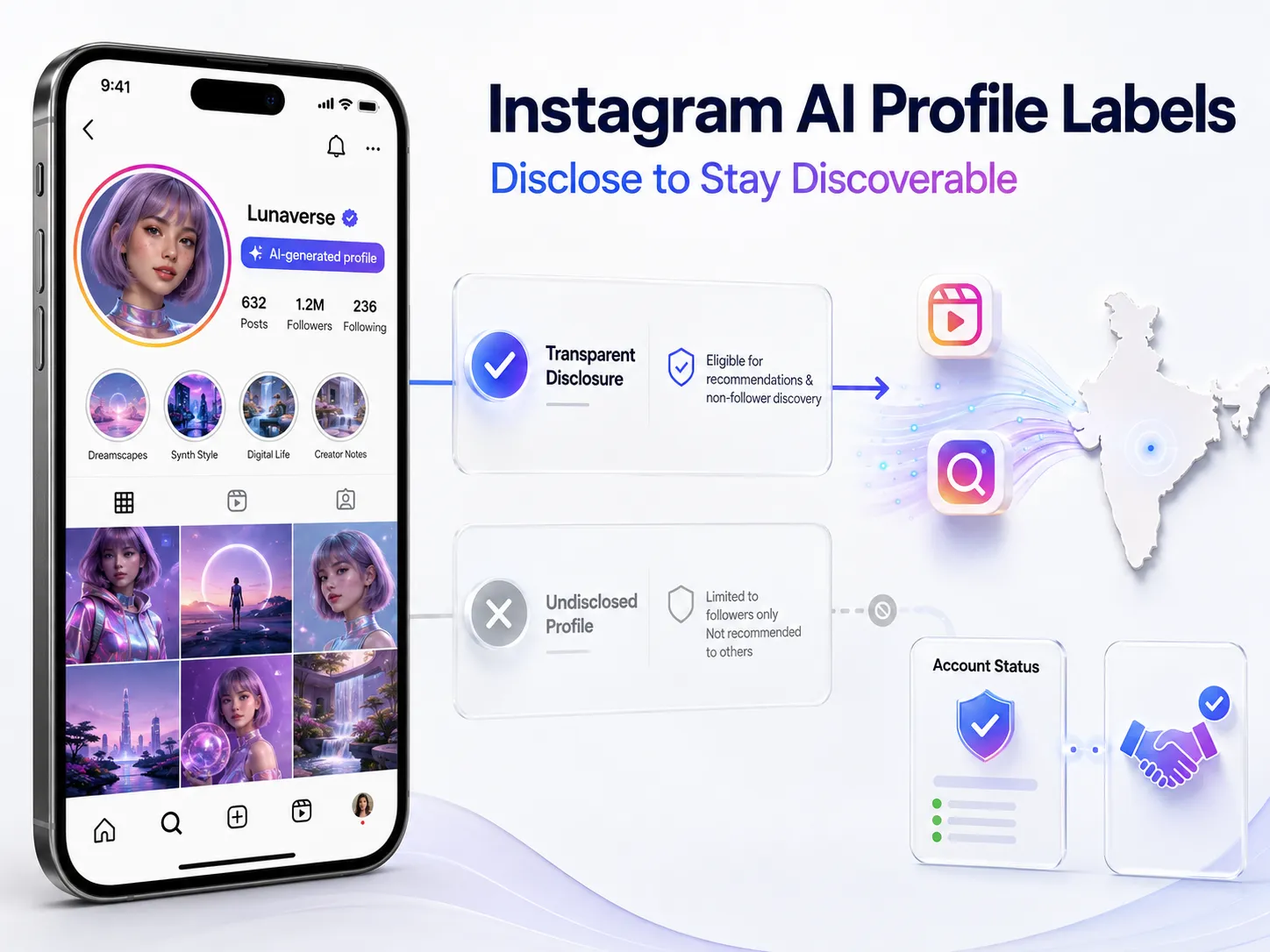
Instagram has introduced a clearer label for profiles that regularly feature an AI-generated person instead of a real human. The platform is replacing the earlier “AI creator” wording with “AI-generated profile” because the old term could be mistaken for a human creator who simply uses AI tools.
The change was announced on 31 August 2026. Instagram also says a relevant profile that does not disclose its AI-generated identity may become ineligible for recommendations to people who do not already follow it. Properly labelled profiles should not lose recommendation eligibility merely because they display the label. Instagram’s official announcement
This is not a ban on AI influencers. It also does not mean every creator who uses AI for captions, editing, backgrounds or ideas needs a profile-level label.
For Indian creators, agencies and brands, the practical issue is whether an account represents a recurring synthetic person who could reasonably be mistaken for a real human—and whether that identity is being disclosed clearly.
Key takeaways
- Instagram announced the change on 31 August 2026.
- The former “AI creator” label is being renamed “AI-generated profile”.
- The label is intended for profiles regularly featuring an AI-generated person rather than a real human.
- Using AI to edit content or prepare captions does not automatically make a human creator’s account an AI-generated profile.
- A relevant profile that remains undisclosed may become ineligible for recommendations to non-followers.
- Recommendation restrictions are not the same as deleting or banning an account.
- Account owners should be able to review recommendation issues through Account Status and appeal an incorrect decision.
- Profile-level disclosure, post-level “AI info” labels and paid-partnership disclosures perform different functions.
- Instagram has not published a fixed percentage by which reach will fall.
- No India-specific deadline or separate national rollout schedule has been announced.
What has Instagram announced?
Instagram is changing the terminology used to identify accounts built around synthetic people.
According to Instagram, the “AI-generated profile” label means an account regularly publishes content featuring an AI-generated person instead of a real human. The label is intended to help users understand the nature of the identity they are following or interacting with. Instagram Help Centre: About AI-generated profiles
The distinction matters because “AI creator” could describe either:
- A fictional personality generated using AI; or
- A real photographer, designer, marketer or influencer who uses AI tools.
The new wording focuses on the first category.
The profile-level label may appear on the account and alongside content, particularly when an individual post does not carry a separate AI-content label.
Has Instagram banned AI influencers?
No. Instagram has not announced a blanket ban on AI influencers, virtual models or synthetic brand characters.
A disclosed AI-generated profile can continue publishing content. Instagram’s stated concern is transparency: users should not be led to believe that a computer-generated person is a real individual.
The reach-related consequence concerns recommendation eligibility. Instagram says an account that should identify itself as AI-generated but fails to do so may not be recommended to non-followers. Instagram’s AI-generated profile announcement
That is different from:
- Deleting the account
- Removing every post
- Preventing existing followers from seeing content
- Prohibiting AI-assisted content creation
- Automatically suspending monetisation
- Banning AI influencers from Instagram
Businesses should therefore avoid headlines claiming that Instagram has “banned AI profiles” or imposed a universal “shadowban”.
Who is the AI-generated profile label intended for?
The clearest use case is an account centred on a recurring synthetic person.
Examples may include:
- A fictional AI fashion influencer
- A virtual travel personality
- A synthetic presenter used across a company’s Reels
- An AI-generated fitness or lifestyle character
- A virtual property adviser presented as a person
- A recurring digital model promoting products
- An account using an AI version of a real person as its primary identity
The relevant question is not simply, “Was AI used somewhere?” It is:
Does this profile regularly present an AI-generated person in a way that users could interpret as a real human identity?
If the answer may be yes, the account owner should review Instagram’s profile-labelling guidance.
What does not automatically require a profile label?
A human creator does not automatically become an AI-generated profile by using AI to:
- Brainstorm Reel topics
- Improve a caption
- Translate text
- Remove a background
- Retouch an image
- Generate subtitles
- Create a visual effect
- Edit audio
- Plan a content calendar
Individual content may still require an “AI info” disclosure depending on how it was produced or altered. That is separate from labelling the entire profile.
Profile labels, content labels and partnership disclosures are different
Creators and brands should treat Instagram’s disclosure system as three separate layers.
| Disclosure | What it explains | Typical use |
|---|---|---|
| AI-generated profile label | The identity presented by the account is an AI-generated person | Virtual influencers and recurring synthetic personalities |
| “AI info” content label | A particular image, video or audio item was generated or materially altered using AI | Individual AI-generated or significantly altered posts and Reels |
| Paid partnership disclosure | A commercial relationship influenced the content | Sponsorships, gifted products and paid brand collaborations |
Meta says it uses technical indicators and user disclosures to apply “AI info” labels to certain AI-generated images, video and audio. Content that was only modified using AI may be labelled less prominently than media detected as AI-generated. Meta’s AI-content labelling approach
Meanwhile, a commercial collaboration remains subject to Instagram’s branded-content requirements. Labelling a personality as AI-generated does not disclose that a brand paid for the post. Instagram’s branded-content guidance
An AI influencer promoting a sponsored product may therefore need both the relevant AI disclosure and a paid-partnership disclosure.
How could an undisclosed AI profile lose reach?
Instagram recommendations help people discover accounts and content they do not already follow. These opportunities can include surfaces such as Reels and Explore. Indian media coverage also reports that suggested content in Feed may be affected. The Indian Express
If Instagram decides that a profile regularly features an AI-generated person but has not disclosed that identity, the account may become ineligible for recommendations to non-followers.
In practice, that could reduce an account’s discovery potential even if existing followers can still visit the profile or see its posts.
Instagram has not published:
- A fixed reach reduction
- A guaranteed number of lost impressions
- An automatic revenue penalty
- A public detection-accuracy figure
- The number of accounts expected to be affected
- India-specific enforcement statistics
It would therefore be inaccurate to predict that every undisclosed AI profile will lose a particular percentage of reach.
Labelling does not guarantee reach
Adding the correct label protects transparency and may resolve a disclosure-related recommendation issue. It does not guarantee that Instagram will recommend the account.
Recommendation eligibility can also depend on Instagram’s wider rules, content quality, audience response and account history. Instagram explains that being eligible does not guarantee that content will be recommended. Instagram’s recommendation guidelines
How can creators check whether their account is affected?
Professional account holders can use Account Status to review whether content or profile information may be affecting recommendation eligibility.
A practical review should include:
- Open the Instagram profile and account settings.
- Locate Account Status.
- Check whether the profile and its content remain eligible for recommendations.
- Review any notice concerning an AI-generated identity.
- Add the correct profile label if the account meets Instagram’s definition.
- Appeal if Instagram has classified a real human account incorrectly.
- Recheck Account Status after the label or appeal has been processed.
Instagram describes Account Status as the place where users can see whether content may lead to restrictions or other limitations. Instagram Help Centre: Account Status
Take screenshots before changing a label, biography or account setting. Record the date and the reason for the change so that later reach comparisons have a reliable reference point.
Is the change available in India?
The announcement is relevant to Instagram accounts in India, including creators, agencies and brands operating AI-generated profiles.
However, Instagram has not published a separate India launch date, Indian compliance deadline or country-by-country rollout schedule. The visibility of a particular label or account control may vary by account and app version.
Indian account owners should check the live options available on their own profiles instead of assuming that every account already displays the same interface.
There is also no reliable public India-specific data showing:
- How many AI-generated profiles use the label
- How many Indian accounts have faced recommendation restrictions
- How much reach an affected account may lose
- Whether enforcement differs between Indian states or cities
The rule is an Instagram platform policy, not an Indian regulation.
Why this matters to Indian creators and businesses
AI avatars and virtual presenters are becoming practical content-production tools for Indian businesses. A property company in Mumbai might use a synthetic presenter for listing explainers. A fashion brand in Delhi may work with a virtual model. An education company in Bengaluru could use an AI teacher character across short-form videos.
The commercial risk arises when the audience cannot tell whether the personality is real.
Poor disclosure can create two problems:
- The account may lose access to non-follower recommendations.
- Customers may feel misled when they later discover that the apparent creator, adviser or spokesperson was synthetic.
Clear disclosure is therefore more than a technical compliance task. It is part of brand trust.
Brands should also examine influencer partnerships
A company working with an AI influencer should not leave every disclosure decision to the profile operator.
Before approving a campaign, the brand or agency should confirm:
- Whether the profile carries an appropriate AI-generated label
- Whether the character could be confused with a real person
- Whether individual AI-generated posts require content-level disclosure
- Whether the paid partnership is disclosed
- Whether the character imitates a recognisable person
- Whether the operator has permission to use relevant faces, voices, music and brand assets
- Whether Account Status indicates a recommendation problem
- Whether the campaign contract allocates responsibility for corrections and appeals
Instagram’s label does not grant permission to use another person’s identity, likeness or intellectual property. Those rights must be considered separately.
The Persona–Post–Partnership–Reach Check
Vertex Social recommends a four-part review for accounts using virtual influencers, avatars or synthetic presenters.
1. Persona: who does the account represent?
Ask:
- Is the recurring person real, synthetic or a combination?
- Could an ordinary viewer reasonably believe the character is human?
- Does the biography clearly describe the character?
- Is the synthetic identity central to the account?
- Is the same AI person used across multiple posts and campaigns?
A clearly fictional mascot is different from a photorealistic virtual influencer presented as a real lifestyle creator.
2. Post: how was each piece of content made?
Review every image, Reel and audio track separately.
Ask:
- Was the media generated using AI?
- Was a real person materially altered?
- Is a synthetic voice being used?
- Does Instagram show an “AI info” label?
- Does the caption need additional context?
- Could the content mislead viewers about an important event, endorsement or result?
The profile label should not replace content-level review.
3. Partnership: is there a commercial relationship?
For sponsored content, ask:
- Was the account paid or given something of value?
- Is the paid partnership disclosed?
- Can viewers understand that the personality is synthetic and the content is sponsored?
- Has the brand approved how its products are represented?
- Are likeness, voice, music and creative rights documented?
AI transparency and advertising transparency can apply to the same post.
4. Reach and account health: can non-followers discover the account?
Check:
- Account Status
- Recommendation eligibility
- Notifications from Instagram
- Recent changes in Reels and Explore discovery
- Whether the profile has been classified correctly
- The outcome of any appeal
- Reach before and after a label or account change
Do not rely on reach alone to diagnose the cause of a decline. Seasonality, content format, audience fatigue, competition and recommendation changes may all influence performance.
Practical examples
| Account activity | Profile-level review | Content-level review |
|---|---|---|
| Fictional AI influencer publishes daily lifestyle content | Label likely relevant | Review each AI-generated post |
| Human creator uses AI to draft captions | Not automatically an AI-generated profile | Usually no visual AI label issue from the caption alone |
| Creator uses an AI background in one Reel | Not automatically a profile-label issue | Content disclosure may be relevant |
| Business uses the same synthetic presenter every week | Review carefully | Review generated video and audio |
| Photographer performs ordinary retouching | Not automatically a profile-label issue | Depends on the extent of the alteration |
| Human creator translates their voice using AI | Not automatically a synthetic profile | Review Instagram’s content guidance |
| Account is built around an AI likeness of a real person | Profile label may be relevant | Consent and rights require separate review |
| Brand sponsors a virtual influencer | Profile label may be relevant | AI and partnership disclosures may both apply |
These examples are practical editorial guidance, not legal determinations. Account owners should evaluate the actual presentation and Instagram’s current instructions.
What Indian creators and brands should do now
Review the account’s central identity
Determine whether followers are interacting with a real creator who uses AI or an AI-generated person designed to function as the creator.
Make the biography unambiguous
A clear biography can reinforce the platform label. Terms such as “virtual character”, “AI-generated personality” or “fictional digital creator” may help audiences understand the account.
Avoid vague wording designed to preserve the impression that a synthetic person is real.
Check every disclosure layer
Review the profile label, individual AI-content labels and paid-partnership disclosures independently.
Examine Account Status regularly
Do not wait for a major reach decline. Include recommendation eligibility in routine account checks, particularly before launching a paid collaboration.
Preserve evidence
Keep screenshots of notices, settings, labels and appeal submissions. Agencies should record approvals and disclosure decisions in the client’s content workflow.
Review old content
A newly labelled profile may still contain earlier posts that could confuse viewers. Review pinned posts, Highlights, biographies and important campaign content.
Monitor meaningful performance
Track non-follower reach, Reels discovery, profile visits, saves, enquiries and conversions. Avoid judging the change from a single post or a short period.
What businesses should avoid
Do not label every AI-assisted creator as an AI-generated profile
Using AI tools does not automatically make a real person synthetic.
Do not hide a recurring synthetic identity
A vague disclaimer buried in an old caption may not provide the profile-level clarity Instagram expects.
Do not assume “AI info” covers sponsorship
AI disclosure and branded-content disclosure answer different questions.
Do not describe the restriction as a ban
Recommendation ineligibility is significant, but it is not the same as account deletion.
Do not promise that adding the label will restore all reach
Correct disclosure may address the classification problem. It cannot guarantee recommendations or performance.
Do not use another person’s likeness without permission
An Instagram disclosure does not resolve consent, copyright, trademark or personality-right issues.
Do not appeal without first checking the account
If the account genuinely centres on a synthetic person, adding the appropriate label may be more suitable than claiming the classification is incorrect.
What remains uncertain?
Several practical details are still unclear:
- Instagram has not disclosed how many profiles will be affected.
- No reach-loss percentage has been published.
- The accuracy of Instagram’s profile-detection systems is unknown.
- No India-specific enforcement figures are available.
- A fixed compliance deadline has not been announced.
- Instagram has not published a complete country-by-country rollout schedule.
- Interface availability may vary between accounts.
- Future changes to the definition or enforcement process remain possible.
- Recommendation eligibility does not guarantee actual distribution.
Creators and agencies should rely on Instagram’s live guidance and their own Account Status rather than third-party claims about guaranteed penalties.
Frequently asked questions
Has Instagram banned AI influencers?
No. Instagram is introducing clearer disclosure and may restrict undisclosed AI-generated profiles from recommendations to non-followers.
Who should use the AI-generated profile label?
It is intended for accounts that regularly feature an AI-generated person instead of a real human.
Does using AI for captions require the profile label?
Not automatically. A real creator using AI for captions or ideas is different from an account built around a synthetic identity.
Will adding the label reduce reach?
Instagram says a profile should not lose recommendation eligibility merely because it correctly displays the AI-generated profile label. The label does not, however, guarantee reach.
What happens if an AI-generated profile remains undisclosed?
The account may become ineligible for recommendations to non-followers, potentially affecting discovery through surfaces such as Reels and Explore.
Is recommendation ineligibility the same as a shadowban?
“Shadowban” is an imprecise term. Instagram provides Account Status and recommendation-eligibility information that should be checked instead of assuming a hidden universal penalty.
Can an account appeal an incorrect classification?
Instagram indicates that account owners can review relevant notices and appeal if they believe a decision is incorrect. A successful appeal may restore recommendation eligibility.
Does the policy apply in India?
The general Instagram announcement is relevant to Indian accounts. However, Instagram has not published a separate Indian deadline or detailed national rollout schedule.
Does an AI influencer need a paid-partnership label?
If the content involves a commercial relationship covered by Instagram’s branded-content rules, the appropriate paid-partnership disclosure may be required in addition to AI disclosure.
Building AI-assisted content without losing audience trust
The safest approach is not to avoid AI altogether. It is to make the role of AI understandable.
A real creator can use AI responsibly without pretending to be synthetic. A virtual influencer can build an audience without pretending to be human. A brand can use AI-generated media while remaining transparent about sponsorship and production.
That clarity should be supported by consistent content planning, account monitoring and a recognisable brand identity. Vertex Social can help businesses review how their Instagram profile, AI-assisted content and customer journey work together without turning disclosure into a fear-driven exercise.